

In the 1950s and early 1960s, long before DJs performed with two turntables and a microphone, Jamaican sound systems were powered by a simpler but remarkably durable machine: the Garrard 4F turntable. This heavy British-built record player became one of the key tools behind the early dancehall movement, helping shape the way Jamaican music was played, heard, and eventually created.
For many early sound system operators, the Garrard 4F was more than just equipment. It was the engine that drove the party.
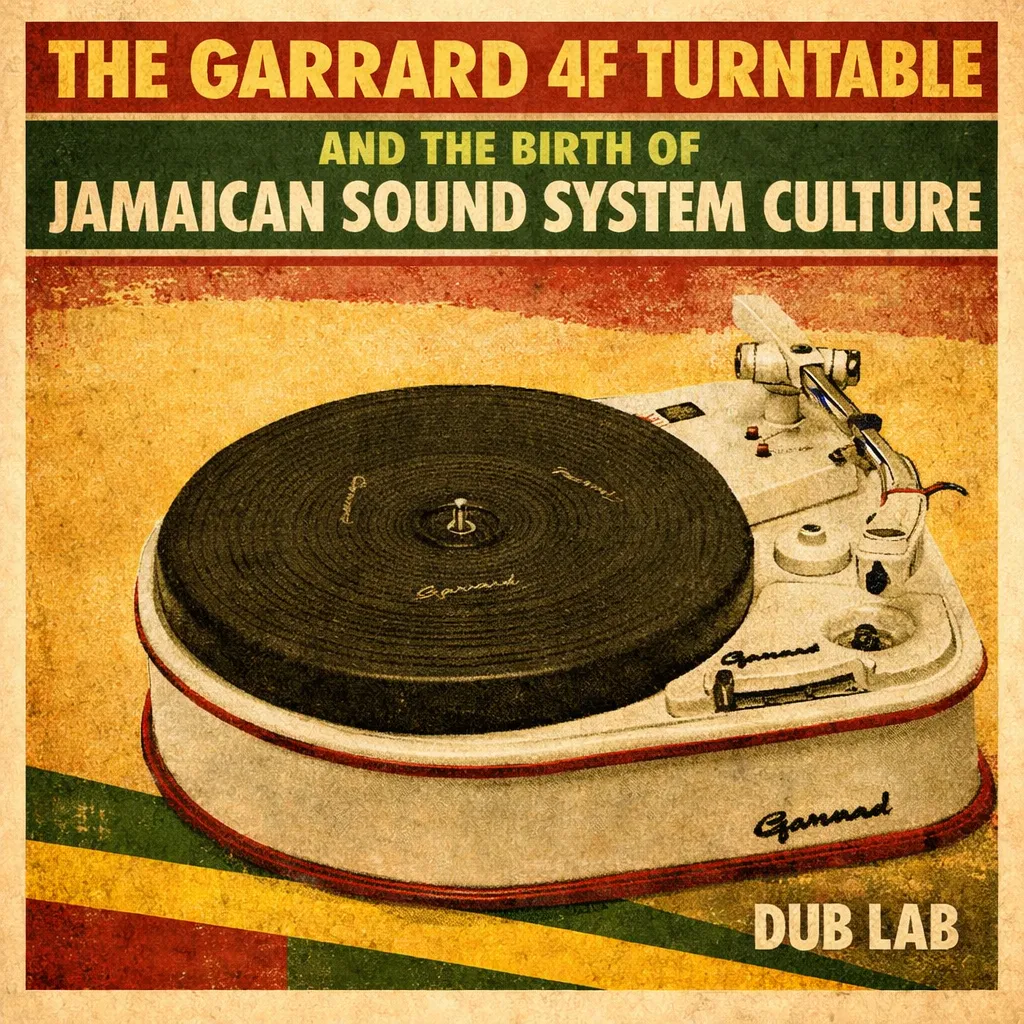
A Turntable Built for Tough Conditions
The Garrard 4F was produced in the early 1950s by Garrard Engineering and Manufacturing Company, a British firm known for building reliable transcription turntables for broadcasting and home hi-fi systems.
Unlike lightweight record players designed for living rooms, the 4F was built like industrial equipment. Its design emphasized stability and strength, qualities that made it ideal for the demanding conditions of outdoor sound system dances in Jamaica.
Key features of the Garrard 4F included:
Heavy cast metal platter that maintained consistent speed
Idler-wheel drive system providing strong torque
78, 45, and 33 RPM speeds to handle different records
Robust mechanical construction able to survive transport and vibration
Sound system operators often mounted the turntable inside large wooden boxes or custom cabinets alongside amplifiers and control panels. Because dances frequently took place in yards or open streets, the equipment had to withstand heat, dust, and constant movement.
The Garrard 4F proved perfect for the job.
Early Jamaican Sound Systems
In the early 1950s, Jamaica was experiencing a musical revolution. Enterprising entrepreneurs began assembling powerful mobile audio rigs known as sound systems. These systems played American rhythm and blues records imported from the United States, blasting them through towering speaker stacks.
Legendary operators like Clement “Coxsone” Dodd, Arthur “Duke” Reid, and Prince Buster built massive followings by hosting outdoor dances across Kingston.
At the center of these early systems were turntables like the Garrard 4F.
But the style of presentation was very different from modern DJ culture.
Before Two Turntables and a Microphone
Today, DJs commonly use two turntables or digital decks to mix between songs seamlessly. That format became standard in Jamaican sound systems during the late 1960s and 1970s as toasting, MC performance, and selector techniques evolved.
In the 1950s, however, the format was much simpler.
Most sound systems used a single turntable, often a Garrard 4F. The selector would place a record on the platter, play the song from start to finish, and then change to the next record. There was little or no mixing between tracks.
Because there was only one deck, the dance floor sometimes experienced brief pauses while the next record was prepared.
These early dances were less about continuous DJ performance and more about the power of the sound system itself. The emphasis was on loudness, bass, and the rare records being played.
Owning exclusive records from American labels could give a sound system a major advantage over its competitors.
The Sound of Early Jamaican Parties
The Garrard 4F helped deliver the music that shaped Jamaican popular culture.
In the early years, sound systems played:
American rhythm and blues
jump blues and boogie-woogie
early rock and roll
Artists like Fats Domino, Louis Jordan, and Rosco Gordon were staples of the Jamaican dance floor.
Eventually, when American R&B began changing in the late 1950s, Jamaican producers started recording their own music. This shift led to the birth of ska, the first major Jamaican popular genre.
The same Garrard turntables that once spun imported records soon played the earliest recordings from studios like Studio One and Treasure Isle Records.
Built for the Sound Clash Era
Another important role of the Garrard 4F was in sound clashes, competitive events where rival sound systems battled for supremacy.
Selectors needed equipment that could start records quickly and play them loudly without mechanical failure. The Garrard’s powerful motor and heavy platter allowed records to reach full speed rapidly, which was essential during heated musical showdowns.
Many veteran operators later recalled that the Garrard turntables were almost indestructible. They could survive years of constant use in outdoor environments where lesser equipment would quickly fail.
A Forgotten but Important Machine
As technology improved, the Garrard 4F was gradually replaced by newer turntables that made cueing and mixing easier. Eventually, the two-turntable-and-microphone format became the standard for sound system performance.
But during the formative years of Jamaican music culture, the Garrard 4F played a quiet but crucial role.
It helped power the early dances where ska was born, where future reggae legends first heard their music played on giant speakers, and where the foundations of modern DJ culture were laid.
Long before selectors spun records with lightning-fast mixes, the Garrard 4F faithfully turned one record at a time, filling Kingston’s night air with sound.
Early Jamaican Sound System Playlist (1959–1964)
Music that would have been commonly played on systems running the Garrard 4F Turntable during the formative years of Jamaican dancehall culture.
Boogie in My Bones – 1959 – Laurel Aitken
Easy Snappin – 1959 – Theophilus Beckford
Oh Carolina – 1960 – The Folkes Brothers
Humpty Dumpty – 1961 – Eric Morris
Best of Friends – 1961 – Derrick Morgan
Independent Jamaica – 1962 – Lord Creator
Forward March – 1962 – Derrick Morgan
Miss Jamaica – 1962 – Jimmy Cliff
Housewives Choice – 1962 – Derrick & Patsy
Judge Dread – 1963 – Prince Buster
Madness – 1963 – Prince Buster
Carry Go Bring Come – 1963 – Justin Hinds & the Dominoes
Wash Wash – 1963 – The Wailers
Shame and Scandal – 1964 – Shawn Elliott
Simmer Down – 1964 – The Wailers
Guns of Navarone – 1964 – The Skatalites
Phoenix City – 1964 – Roland Alphonso
Freedom Sounds – 1964 – The Skatalites
Man in the Street – 1964 – Don Drummond
Eastern Standard Time – 1964 – Don Drummond