

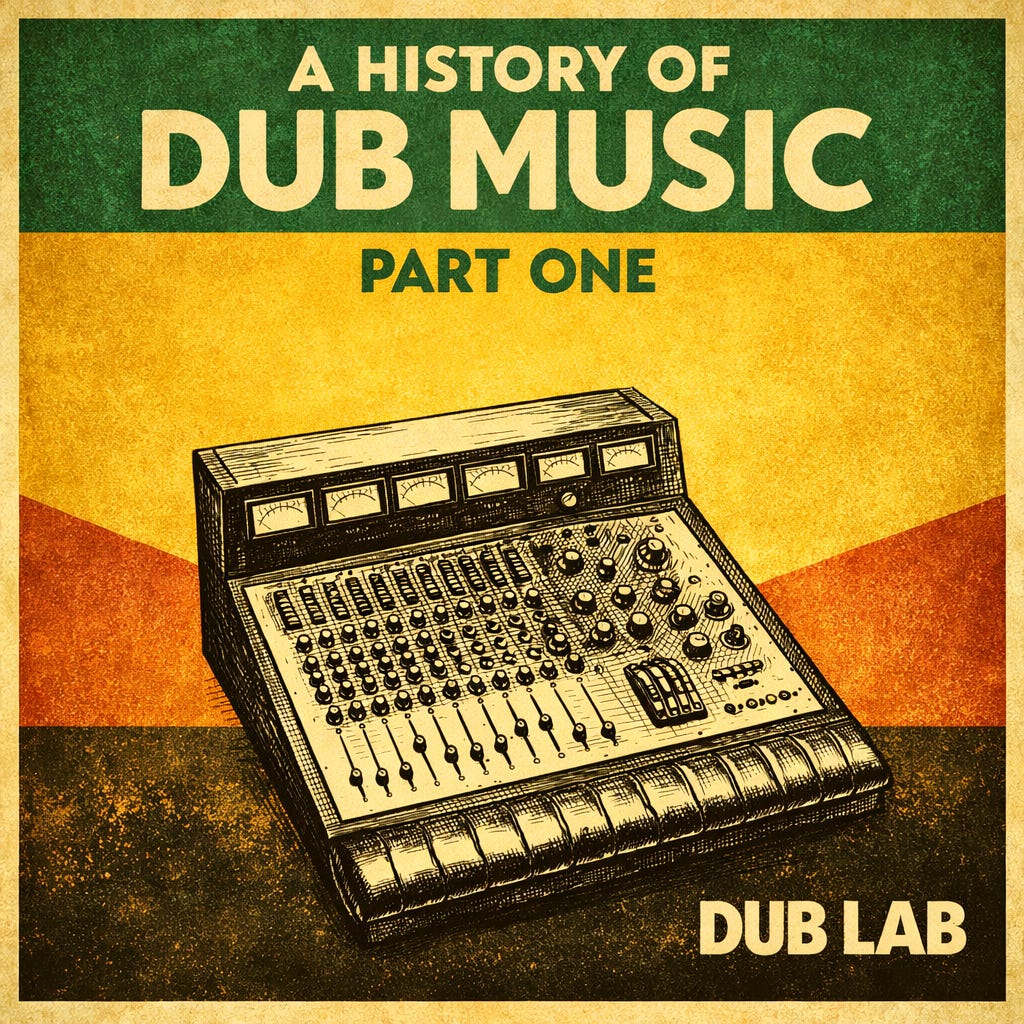
Dub music did not appear suddenly. It grew from a very specific time and place: post-colonial Jamaica in the late 1950s and 1960s. In that environment, economic hardship, ingenuity, and a powerful sound system culture shaped one of the most influential studio innovations in modern music. Dub transformed recording technology into an instrument and laid the groundwork for remix culture, hip-hop, electronic music, and later forms such as dubstep.
Between 1959 and the end of the 1970s, Jamaican producers, engineers, and sound system operators developed techniques that fundamentally changed the role of the recording studio. Their experiments with echo, reverb, drop-outs, and bass reshaped the structure of recorded music and introduced the idea that a mix could be as creative as the composition itself.
The Roots: Jamaican Sound System Culture (Late 1950s–Early 1960s)
Dub’s story begins with Jamaican sound systems. These were large mobile DJ setups that played records at street dances across Kingston and other towns. The system operators competed fiercely for crowds, often modifying equipment and seeking exclusive recordings.
Among the most important early sound system operators were Clement “Coxsone” Dodd, Arthur “Duke” Reid, Prince Buster, and Tom the Great Sebastian. Their systems became cultural institutions in Kingston neighborhoods such as Trench Town, Downtown Kingston, and Spanish Town.
At the time, Jamaica had limited access to expensive imported records from the United States. As a result, sound system operators began producing their own recordings locally. This led to the creation of Jamaica’s recording industry.
The first styles that developed in this environment were ska and later rocksteady. These styles emphasized rhythm sections and horn arrangements, but they also reflected everyday Jamaican life. Many musicians came from poor neighborhoods where music offered a rare path to stability.
Economic realities influenced the equipment available in early Jamaican studios. Most studios operated with minimal gear: a few microphones, basic tape machines, and simple mixing desks. Yet the engineers working in these spaces were remarkably inventive.
One of the earliest studios central to dub’s development was Studio One, founded by Coxsone Dodd in Kingston. Another was Treasure Isle, run by Duke Reid. These studios recorded many of the musicians who would later shape reggae and dub.
The Emergence of Version Culture
In the mid-1960s, Jamaican producers began experimenting with a practice known as “versions.” These were instrumental versions of popular songs, often placed on the B-side of a vinyl single.
Sound system DJs—known in Jamaica as toasters—would talk or chant over these instrumental tracks at dances. This practice laid the groundwork for both dub and hip-hop.
The origins of the first “version” are often attributed to Ruddy Redwood, a sound system operator who in 1967 obtained a test pressing of The Paragons’ “On the Beach.” The pressing accidentally lacked the vocal track, leaving only the instrumental rhythm. When Redwood played it at a dance, the crowd loved it.
Producers quickly realized that instrumental versions gave sound systems something unique to perform with. This created a demand for more stripped-down mixes.
This moment marked the first step toward dub. It shifted attention from the song to the rhythm track, known in Jamaica as the “riddim.”
King Tubby and the Birth of Dub
No individual is more closely associated with the invention of dub than King Tubby (Osbourne Ruddock).
Tubby was originally an electronics repair technician in Kingston. He built and modified amplifiers for sound systems and ran his own system called King Tubby’s Hometown Hi-Fi, based in the Waterhouse neighborhood.
Because of his technical skills, producers began bringing him recordings to cut into dubplates—custom acetate discs used by sound systems. Tubby also began experimenting with the recordings themselves.
By the late 1960s and early 1970s, Tubby had developed techniques that would define dub music.
These included:
Removing vocal tracks to emphasize rhythm sections
Using spring reverb and tape delay
Dropping instruments in and out of the mix
Boosting bass and drums
Creating dramatic spatial effects
Tubby treated the mixing board like an instrument. Instead of simply balancing sound levels, he actively reshaped the music during the mixing process.
This approach created entirely new versions of existing songs.
One of the most important early producers who worked with Tubby was Bunny Lee, a prolific Jamaican producer whose recordings became the foundation for many classic dub mixes.
Tubby’s work appeared on albums such as “Blackboard Jungle Dub” (1973), produced by Lee “Scratch” Perry. This record is often cited as the first full-length dub album.
Lee “Scratch” Perry and the Black Ark Studio
Another central figure in dub’s development was Lee “Scratch” Perry, a producer known for his wildly experimental approach to recording.
Perry built the legendary Black Ark Studio in Kingston during the early 1970s. The studio was small and modest, but Perry used it to produce some of the most innovative reggae and dub recordings ever made.
Perry’s production style was unconventional. He manipulated tape machines, layered sounds in unusual ways, and sometimes used found objects or environmental noises in recordings.
His mixes emphasized atmosphere and texture. Rather than simply isolating rhythm tracks, Perry often treated the studio itself as a creative instrument.
The Black Ark studio became a hub for major artists including Bob Marley and the Wailers, The Heptones, and Junior Murvin.
Perry’s dub work helped establish dub as more than a technical experiment. It became a distinct artistic genre.
The Rise of Dub Albums
By the mid-1970s, dub had evolved into a recognized musical style.
Producers began releasing albums composed entirely of dub mixes. These albums featured stripped-down versions of reggae tracks with heavy use of echo, reverb, and instrumental manipulation.
Among the most influential producers and engineers of this period were:
King Tubby
Lee “Scratch” Perry
Errol Thompson
Joe Gibbs
Prince Jammy (later King Jammy)
Scientist
Augustus Pablo
The partnership between Joe Gibbs and engineer Errol Thompson produced a series of important albums known as “The African Dub” series, which showcased sophisticated mixing techniques.
Similarly, Prince Jammy, who apprenticed under King Tubby, developed his own mixing style and later became one of Jamaica’s most important producers.
Another major figure was Scientist, a young engineer who worked at King Tubby’s studio and later released a series of influential albums such as “Scientist Rids the World of the Evil Curse of the Vampires.”
These records helped popularize dub internationally.
Augustus Pablo and the Melodica Sound
Augustus Pablo introduced a distinctive melodic element into dub through his use of the melodica, a small keyboard wind instrument.
Pablo worked closely with King Tubby and released albums such as “King Tubby Meets Rockers Uptown.”
This track became one of the most famous dub recordings ever made. It demonstrated how dub could blend instrumental performance with studio manipulation.
Pablo’s productions emphasized deep bass, spacious reverb, and hypnotic rhythms.
Techniques That Defined Dub
Dub producers relied on a small number of key techniques that transformed reggae recordings.
Tape Delay
Tape delay was created by running audio through a tape machine and feeding the signal back into itself. This produced repeating echoes that could be manipulated in real time.
Spring Reverb
Spring reverb units created a metallic echo effect that became a signature element of dub mixes.
Dropouts
Engineers would suddenly remove instruments from the mix and then bring them back in dramatically. This created tension and rhythmic surprise.
Bass Emphasis
Dub placed heavy emphasis on bass and drums. Producers often boosted low frequencies far beyond typical recording standards.
Live Mixing
Dub mixes were often performed live during the mixing process. Engineers physically moved faders and triggered effects while recording the final version.
This approach made each mix unique.
The Socioeconomic Environment
Dub developed during a turbulent period in Jamaican history.
The island gained independence from Britain in 1962, but economic inequality remained widespread. Many Kingston neighborhoods faced unemployment, overcrowding, and limited opportunities.
Music became a powerful form of expression and survival.
Sound system dances were inexpensive forms of entertainment that brought communities together. These events often took place in open yards, street corners, or community spaces.
Because imported equipment was expensive, engineers learned to modify or repair gear themselves. This DIY spirit shaped dub’s experimental culture.
Political tensions during the 1970s also influenced reggae and dub. Jamaica experienced violent conflicts between rival political parties, particularly in neighborhoods like Waterhouse and Tivoli Gardens.
Music offered both escape and commentary on these conditions.
International Spread
By the late 1970s, dub had begun spreading beyond Jamaica.
Reggae musicians touring the United Kingdom introduced dub to new audiences. Jamaican immigrants in cities such as London, Birmingham, and Bristol established sound system cultures similar to those in Kingston.
British reggae labels began releasing dub records, helping the style reach a global audience.
The influence of dub soon extended beyond reggae. Its studio techniques inspired producers in rock, punk, and electronic music.
Bands such as The Clash incorporated dub mixing ideas into their recordings.
The End of the First Era
By the end of the 1970s, dub had matured into a fully developed genre.
King Tubby remained one of its central figures, while engineers like Prince Jammy and Scientist continued pushing the boundaries of mixing technology.
Dub also set the stage for future developments in Jamaican music.
The rhythmic emphasis on bass and drums influenced the emergence of dancehall in the late 1970s and early 1980s.
At the same time, dub’s concept of remixing existing recordings would shape music production worldwide.
From hip-hop DJs in the Bronx to electronic producers in Europe, the idea that a mix could become a new composition originated in the Jamaican dub studios of the 1970s.
Legacy of the First Dub Era
Between 1959 and 1979, dub evolved from an accidental instrumental B-side into one of the most innovative forms of recorded music.
The work of pioneers like King Tubby, Lee “Scratch” Perry, Prince Jammy, Scientist, Augustus Pablo, Joe Gibbs, and Errol Thompson created a new relationship between technology and musical creativity.
Dub also demonstrated how music created in economically marginalized communities could reshape global culture.
What began in the yards and studios of Kingston would eventually influence genres ranging from hip-hop to techno, ambient, drum and bass, and dubstep.
The next era of dub would take these ideas far beyond Jamaica, transforming them through digital technology and international collaboration.
Deeper Listening
Blackboard Jungle Dub — 1973 — The Upsetters
Pick a Dub — 1974 — Keith Hudson
Dub from the Roots — 1974 — King Tubby
African Dub All-Mighty Chapter 1 — 1975 — Bunny Lee
King Tubby Meets Rockers Uptown — 1976 — Augustus Pablo & King Tubby
Super Ape — 1976 — The Upsetters
East of the River Nile — 1977 — Augustus Pablo
Leggo Dub — 1978 — Joe Gibbs
Scientist Rids the World of the Evil Curse of the Vampires — 1979 — Scientist
Rockers Meets King Tubby in a Firehouse — 1979 — King Tubby & Augustus Pablo
- Dubby