

The folding knife known in Jamaica as the “ratchet” occupies a strange and fascinating place in cultural history. It began as a practical German-made working knife at the start of the twentieth century, designed for farmers and laborers in Africa. Yet by the 1960s it had become one of the most recognizable symbols of Jamaica’s urban youth culture, immortalized in rocksteady and reggae songs and associated with the rebellious “rude boy.” The knife’s journey from Germany to Kingston dance halls is an example of how objects can travel across continents and take on new meanings in entirely different cultures.
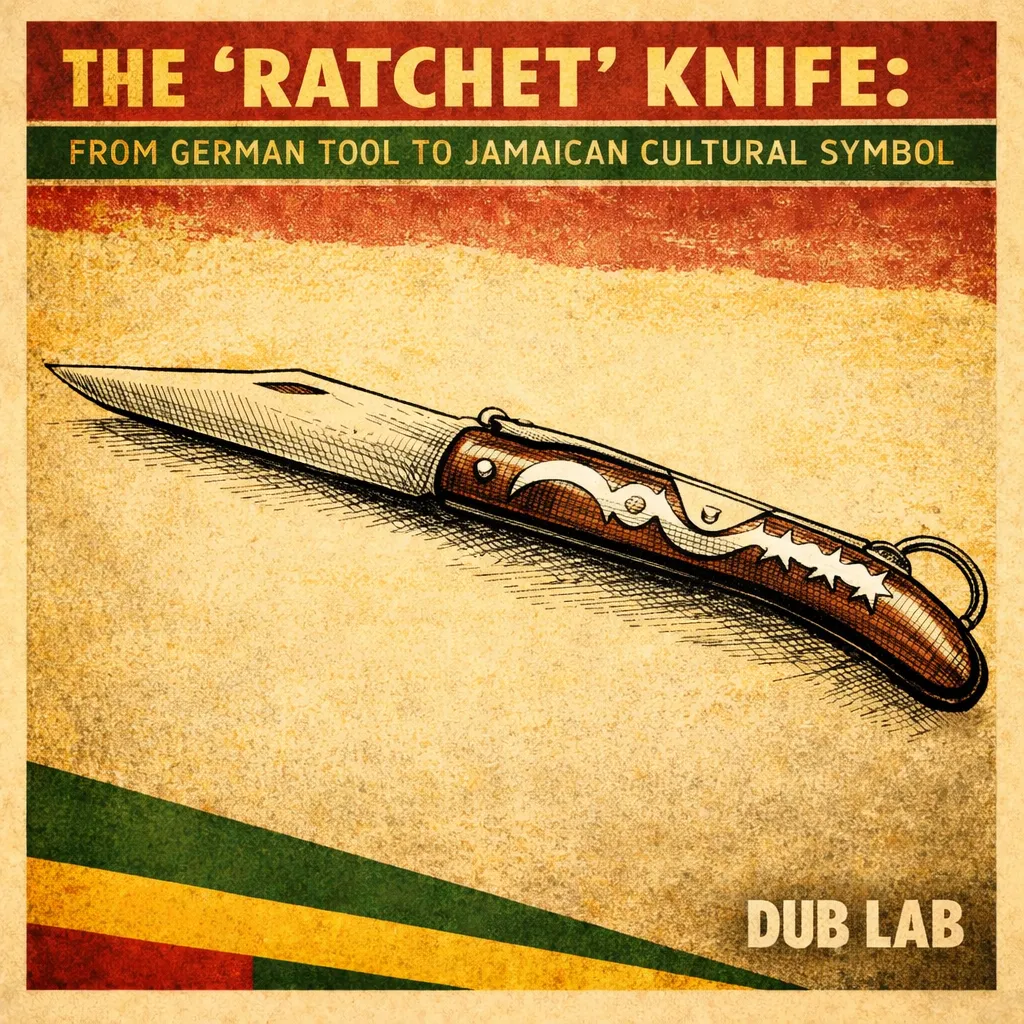
German Origins of the Okapi Knife
The Okapi knife was first produced in 1902 by German manufacturers who intended it for export to the German colonial territories in Africa. The name “Okapi” came from the okapi, a distinctive giraffe-like animal native to central Africa.
The knife was designed as a rugged but inexpensive folding tool that could survive harsh use. It was never meant to be luxurious. Instead it was built with practicality in mind, aimed at farmers, hunters, and laborers who needed a dependable cutting tool. The design quickly proved successful and became widely distributed across Africa and other parts of the world.
Over time, the knife developed a reputation as a durable working blade. The typical construction included:
1055 carbon steel blade known for holding a sharp edge
Wooden handle scales, often resin-impregnated cherry wood
Long narrow blade profile suited for slicing and utility work
A distinctive ratchet locking mechanism that made the blade secure when open
For decades the knives were manufactured in Germany, though production later moved to South Africa in 1988 when the trademark and tooling were acquired by a South African company.
Despite its humble design, the Okapi knife developed a cult reputation for toughness and simplicity. That reputation helped it travel far beyond the markets it was originally designed for.
The Ratchet Mechanism and Design
What made the Okapi distinctive was its ratchet lock, which gave the knife its Jamaican nickname.
Instead of a modern locking system, the knife uses a spring-loaded back lock with a ratcheting gear along the spine of the blade. As the blade opens, it clicks through a series of teeth until it locks into place. The user releases the blade by pulling a metal ring at the end of the handle, disengaging the spring so the blade can fold closed.
This design has several practical advantages:
Strength and reliability – The locking teeth hold the blade firmly in place.
One-handed opening – Skilled users can flick the knife open quickly.
Simple construction – Few parts mean the knife rarely fails.
Affordability – The knife was cheap enough for everyday laborers.
The ratchet sound itself became iconic. The clicking noise when opening the blade gave the knife a mechanical character that people remembered. In Jamaica that sound became part of its identity, reinforcing the nickname “ratchet knife.”
Arrival in Jamaica
By the mid-twentieth century German-made folding knives, especially the Okapi, were circulating widely throughout the Caribbean. Imported goods flowed into Jamaica through shipping routes connected to Europe, Africa, and the United Kingdom.
The knives were cheap, durable, and easy to carry, making them popular among working-class Jamaicans. Like in Africa, they served ordinary purposes such as:
cutting sugar cane or fruit
fishing and hunting
general household tasks
But in Jamaica the knife soon developed another reputation. It became associated with the young urban men known as “rude boys.”
Rude Boys and the Rise of Rocksteady
During the early 1960s Jamaica experienced major social changes. Independence from Britain in 1962 created hope for prosperity, but many young people in Kingston’s crowded neighborhoods found themselves unemployed and marginalized.
A generation of streetwise youths emerged in places like Trench Town. These young men adopted sharp fashion, swaggering attitudes, and a reputation for toughness. They became known as rude boys.
The rude boy culture quickly merged with Jamaica’s sound system scene and popular music. Artists wrote songs both celebrating and criticizing these street figures.
Within this subculture the ratchet knife became an emblem of masculinity and self-defense. German folding knives were easy to conceal and quick to open, making them popular among young men navigating the rough urban environment.
Music reflected this reality. Producers and singers referenced rude boys and their weapons in lyrics that ranged from warnings to outright glorification.
The Rocksteady Era: 1966–1967
The period between 1966 and 1967 marked the height of rocksteady, a short-lived but extremely influential genre that bridged ska and reggae. Rocksteady slowed the tempo of ska and emphasized bass lines and vocal harmonies, creating a smoother groove.
This musical shift coincided with the peak of rude boy culture. Many songs described street life, crime, or the romanticized image of the rebellious youth.
Writers often referred to the ratchet knife as part of the rude boy persona. The knife symbolized both danger and style. It represented a young man prepared to defend himself in Kingston’s tense social environment.
Some songs condemned rude boys, warning them about violence or prison. Others portrayed them as anti-heroes navigating a harsh world. Either way, the ratchet knife became one of the most recognizable symbols of the era.
The Knife in Jamaican Music and Culture
As rocksteady evolved into reggae in the late 1960s and 1970s, the imagery of rude boys remained deeply embedded in Jamaican music. Artists continued to reference the ratchet knife in lyrics describing street confrontations, survival, or outlaw swagger.
The knife also appeared outside of music. In certain Rastafarian circles, the blade was used as a practical tool, including for preparing cannabis in ritual settings.
Over time the ratchet became almost mythical in Jamaican folklore. It represented a blend of:
street survival
working-class practicality
rebellious youth culture
Few objects illustrate the intersection of everyday life and music culture as vividly as the Okapi ratchet.
Keith Richards and the Jamaican Ratchet
Another interesting chapter in the knife’s story involves Keith Richards, guitarist of the Rolling Stones.
During visits to Jamaica in the 1970s Richards became fascinated with Jamaican culture and reggae music. At some point he was reportedly given a large Okapi ratchet knife in Jamaica, which he carried for many years.
A Cultural Artifact
Today the Okapi ratchet knife remains widely known in Jamaica and across parts of Africa. Although originally intended as a utilitarian tool, it gained cultural meaning far beyond its mechanical design.
In Jamaica it became:
a street symbol of the rude boy era
a lyrical motif in rocksteady and reggae
an artifact of 1960s urban culture
Few knives have such a unique cross-cultural journey. What began as a German export tool eventually became woven into the soundtrack and mythology of Jamaican music.
Ten Jamaican Songs (1966–1986) Referencing the Ratchet
Below is a selection of songs from the rocksteady and reggae era that reference rude boys or ratchet knives in their lyrics or themes:
Desmond Dekker & The Aces – “007 (Shanty Town)” (1967)
Prince Buster – “Judge Dread” (1967)
The Clarendonians – “Rudie Bam Bam” (1966)
Derrick Morgan – “Tougher Than Tough (Rude Boy)” (1967)
Joe White – “Rudies All Around” (1967)
The Valentines – “Blam Blam Fever” (1967)
The Wailers – “Rude Boy” (1965, widely played through the rocksteady era)
Prince Buster – “Too Hot” (1967)
U-Roy – “Wake the Town” (1970)
Yellowman – “Rude Boy Skank” (1980s dancehall era)
These songs capture the era when Jamaican music reflected the realities of Kingston street life. Within that world the ratchet knife became more than just a blade. It became part of the iconography of reggae’s earliest years.